
Learn about Low impact Development
On This Page
Slow It. Spread It. Soak It. Source Control.
What is Low Impact Development?
LID is a comprehensive approach to site planning, design, and pollution prevention that, when combined, can create a more economically sustainable and attractive landscape that conserves and protects water quality.
10 Reasons for LID
LID, or Green Stormwater Infrastructure, works with nature to manage or utilize stormwater as close to its source as possible. It uses site drainage that restores the ecological integrity of receiving waters, and it can reduce construction, maintenance, and inspection costs.
- Can reliably remove 80% of total suspended solids in runoff
- Detains water on site
- Development project cost savings
- Uses rainwater for irrigation to save potable water
- Traps trash at the source
- Adds landscaping to the site
- Adds habitat for wildlife
- Offers multiple ecosystem services
- Architectural certifications add value to the project
- Facilitates coordination between professional disciplines
LID Practices
Low Impact Development (LID) helps retain soil, conserve water, manage stormwater naturally, and protect the environment over the long term. LID strategies capture and retain rainwater for irrigation or treatment, use plants and soil to filter runoff, and incorporate features like rain gardens, bioswales, or constructed wetlands into attractive landscaping. These approaches often cost less than traditional “hard” engineering solutions, like large concrete channels or detention basins.
LID practices provide both water quality treatment and runoff reduction, and combining multiple practices can improve results. Travis County, the Lower Colorado River Authority (LCRA), the Texas Commission on Environmental Quality (TCEQ), and surrounding municipalities require Permanent Water Quality Controls when development permit applications propose the addition of impervious cover exceeding established thresholds – in Travis County, that threshold is 10,000 square feet. LID can reduce effective impervious cover and may be used alone or with other stormwater controls.
Resources for LID Designs:
- HLWO Water Quality Management Technical Manual
- City of Austin Environmental Criteria Manual
- Edwards Aquifer Protection Program
Erosion Prevention & Sediment Controls
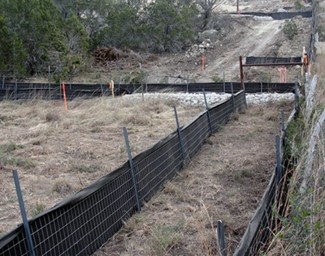
Develop and implement an erosion and sediment control plan before construction begins. Proactive methods will also prevent violations of federal, state, and local regulations governing storm water pollution. Readily available technical guidelines specify many structural controls for handling erosion and sediment once land is disturbed. However, there are several smart, money-saving practices that can be employed to prevent pollution from a construction site and avoid violations or work stoppages:
- Phase construction to reduce the amount of disturbance at any given time. Use topographically low areas as places to install sediment traps or sediment ponds.
- Divert upland runoff around your construction site whenever possible so upstream runoff can flow on without picking up loose soil from your disturbed and exposed soil
- Shield and protect sensitive features like wetlands, waterways, and karst recharge areas. Limit disturbance and divert runoff away from these features whenever practical.
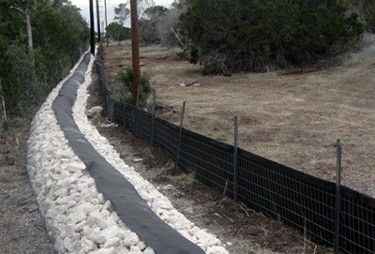
- Preserve existing ground cover if possible. If topsoil needs to be removed for grading or surface development, stockpile it if practical and use it later for re-vegetation.
- Travis County requires construction setbacks in some cases to protect established waterways or critical environmental features. Within setbacks, construction is generally prohibited. Preserving natural vegetation near waterways is a key measure that results in low impact development and preservation of water quality.
- It is recommended to sequence construction work from lower elevations first to upgradient locations last, stabilizing and re-vegetating disturbed areas immediately after grading work is completed. Whenever feasible, "rough cut" water quality and detention ponds first to allow these impoundments to collect sediment.
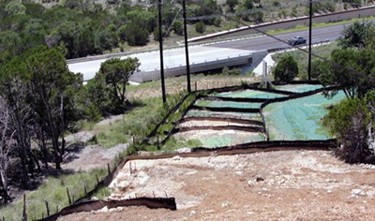
- In project planning, consider the time of year when site disturbance is completed and when re-vegetation will occur. Re-vegetation or other soil stabilization methods are required promptly following the end of construction, regardless of time of year. To reduce environmental impacts and conserve water, avoid the need to plant seed and irrigate disturbed areas in the hottest time of the year. It is recommended to plant native, drought resistant grasses when it will readily germinate. Otherwise, plant seasonally appropriate grasses to establish temporary cover and follow with native, drought resistant grasses when the appropriate season arrives.
Development Planning
"Integrate storm water management techniques in the site development planning from the outset. Identify, reserve, and design your project around the most favorable locations for storm water infiltration based on elevation, soil type, and permeability." (Arendt, R.)
Bring Together Planners, Ecologists, Building & Landscape Architects, Engineers, & Contractors to Design Your Development Plan
When these groups collaborate, they can design the site with water flow in mind. This often leads to a design that looks better, costs less to build, and can increase property value. Also, design and construction professionals who expand their expertise should expect their services to be more coveted and marketable than traditional service providers.
Travis County Code (Sec. 482.915), allows developers or property owners the ability to convene a pre-application meeting with Travis County TNR staff to discuss the project prior to uploading permit or plat applications for review. Travis County encourages developers to use this opportunity to discuss site-specific restraints, identify how the project can limit environmental impacts, and to discuss any regulatory challenges that may need resolutions. Pre-application meetings can be scheduled on our permitting system
Travis County has incentives available for Conservation Development. See Travis County Code Sections 482.220 – 482.241 for details. When implemented, conservation development preserves native vegetation, sensitive ecological habitat, and open space.
LID Examples:

Bioretention

Infiltration

Rain Garden
Bioretention – an attractive landscaped water quality basin that functions as a soil and plant-based infiltration device
Rain gardens – a small-scale bioretention facility that collects runoff from small drainage areas such as roof-tops or small parking areas
Infiltration/filter strips – trenches, basins, and filter strips that direct runoff into suitable soils to remove pollutants and promote recharge
Pervious pavement – materials used in parking lots, sidewalks, and roads that allow runoff to flow through the surface into water storage areas or suitable natural soil.
Rainwater harvesting – collection of roof-top runoff into tanks or basins and using the stored water for beneficial purposes to reduce water supply demands
Roof-top disconnection - runoff is directed from the downspout onto vegetated surfaces to promote infiltration and filtration to reduce runoff rate and volume
Soil amendment – use of native soils at appropriate depths and native turf grasses to infiltrate and reduce runoff volume
Conservation landscaping – use of native soils at appropriate depths and native plants, shrubs, trees, and perennials to reduce runoff volume and limit chemical application
Natural area preservation – conservation of natural areas within development sites to retain pre-development runoff quantity and quality characteristics

Conservation Landscaping

Pervious Pavement

Roof-Top Disconnection
For further information on approvable Green Stormwater Infrastructure, sizing calculations, and design details, please follow the link to the HLWO Water Quality Management Technical Manual, the City of Austin ECM,and TCEQ Edwards Aquifer Protection Program. Travis County has adopted these technical criteria by reference for development projects located in either the western or eastern watersheds of the county.
LID Development Requirements
The following discussion addresses specifically the areas within Travis County that are outside of the corporate limits of any municipality and outside of the extra-territorial jurisdiction (ETJ) of a municipality. Keep in mind that within the ETJ of a municipality, the municipality will also need to provide concurrence with specific improvements. Travis County does not issue development permits within corporate limits, and the municipality should be consulted solely.
Permitting considerations for LID systems include:
1. LID Systems within Residential and Commercial Subdivisions
Subdivision-related drainage and water quality features are traditionally located within drainage and water quality easements or lots. These easements and lots are required to be maintained by a Homeowners Association, Property-owners Association, or a Special District, such as a Municipal Utility District (MUD) or Water Control Improvement District (WCID). Low impact BMPs can easily be accommodated within this scenario, as they are shown in and permitted within the subdivision construction plan, and are reviewed against Travis County's water quality requirements, which allow for non-standard approaches that achieve the water quality levels of standard systems. The maintenance of drainage easements and lots must be spelled out in detail on the final plat and within easement documents.
2. LID Systems within Commercial Site Plans
Within a commercial site plan, the maintenance of drainage and water quality improvements are the responsibility of the property owner, allowing for a considerable amount of flexibility in the design of water quality systems. As long as systems are found to provide the required level of water quality, they will likely be approved for use within these areas.
3. LID Systems within Private Street Subdivisions
With the approval of Commissioners Court, private streets may be constructed within residential or non-residential subdivisions. Private streets are located within Private Lots, and are traditionally maintained (as identified on the plat) by a Homeowners Association, Property-owners Association, or a Special District, such as a MUD. Similarly to the discussion under Commercial Site Plans above, a considerable amount of flexibility is available regarding the placement of appropriate LID BMPs within these Private Street lots. As long as roadway integrity, public safety, and water quality requirements are met, LID features within these lots are likely to be approved.
4. LID Systems within Travis County Right of Way
In order to ensure the safety and well-being of the general public, any privately-owned and maintained improvement, either existing or proposed, which encroaches into County rights-of-way requires the issuance of a License Agreement.
With the approval of Travis County Commissioners Court, a license agreement with Travis County may be approved which will allow for certain non-standard improvements to be constructed and maintained by a responsible party within Travis County rights-of-way.
License agreements and templates are found in Travis County Code Chapter 482.701 and in the License Agreements section.
License Agreements
License Agreements provide for liability insurance, fiscal for the removal of improvements if that should become necessary, and indemnification of Travis County for any problems related to the construction and maintenance of the licensed improvements.
Traditionally, license agreements have been utilized to allow for the construction and installation of such non-standard improvements such as entry monuments, landscaping features and plantings, and irrigation improvements. Low Impact BMPs may also be found to be appropriate within the context of a license agreement, as long as the roadway functioning, integrity, and safety of the public is adequately addressed. Any improvements covered by a license agreement will require permitting by Travis County and will need to be included in a sealed engineered plan. Clear zone and sight distance issues will be required to be documented and addressed during the permit review process.
The license agreement will need to clearly identify the licensed area within the rights-of-way and will reference the Travis County permit number authorizing the licensed improvements. You will need to work with your permit reviewer to determine the specific improvements that will be acceptable to be located within Travis County rights-of-way. Please keep in mind that the safety of the public and the integrity of the roadway system will be the priority when considering other improvements within the right-of-way.
License Agreements will also provide for liability insurance, fiscal for the removal of improvements if that should become necessary, and indemnification of Travis County for any problems related to the construction and maintenance of the licensed improvements.
Possible Low Impact Water Quality BMPs that on a case-by-case basis might be approved for location within the right of way:
- Vegetative Swales
- Rain Gardens
- Stormwater infiltration features
- Landscaping
- Water Quality ponds
Please note that the improvements will be required to meet safety and clear zone requirements and Travis County development code requirements for engineering design.
License agreements and templates are addressed in Travis County Code Chapter 482.
Rainwater Harvesting
Rainwater harvesting is an innovative alternative water supply approach anyone can use that offers a small-scale BMP to reduce stormwater runoff and the erosion or scouring associated with it.
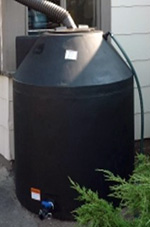
By harvesting the rainfall and storing it, a property owner can slowly release the water back into the soil, either through irrigation or direct application. The water then slowly percolates into the groundwater table, providing a steady supply of water to local streams and rivers.
Items needed for a basic rainwater harvesting system:
- A catchment area, likely a roof
- Metal roofs work best, but any roof will work for non-potable water
- Gutters with downspouts
- Screens to catch leaves and debris from catchment area
- Rain barrels
- Delivery system to landscape (spigots, hoses, pumps, etc.)
Integrated Pest Management (IPM) & Lawn Fertilizer Use
IPM is a non-structural environmentally sensitive and low impact approach to pest management. Landscapes are monitored regularly, problems properly identified, severity considered, control options evaluated, and the least-toxic controls are selected and implemented.

Effective IPM includes:
- Accurately diagnosing pest problems before considering any treatment
- Using least-toxic solutions when addressing landscape problems
- Not applying fertilizer or pesticides before a rain
- Not killing every bug (95% of insects are not pests)
- Using pesticides as a last resort
- Always reading and following pesticide label instructions
- Encouraging beneficial insects
- Considering whether the soil is deficient in nutrients through chemical analysis before applying fertilizer