
Travis County and the City of Austin are updating the Balcones Canyonlands Conservation Plan (BCCP) and seeking renewal of its federal permit. The plan helps protect endangered species while providing a streamlined path for eligible development and infrastructure projects to comply with the Endangered Species Act. Learn about the renewal process and opportunities to get involved.
On this page
BCCP Permit Renewal Overview
The BCCP has reached the end of its 30-year permit term and Travis County and the City of Austin are updating the BCCP and have applied to renew the federal incidental take permit (“ITP” or “permit”) that authorizes its implementation. The renewal provides an opportunity to reflect current regulatory requirements, conservation needs, best available science, and implementation practices. Throughout the renewal process, the existing BCCP will remain operational, and the Balcones Canyonlands Preserve (“BCP” or “Preserve”) continues to be conserved and managed in perpetuity.
Travis County and the City of Austin have retained habitat conservation planning consultant, ICF International, Inc., to support and facilitate the renewal process, which is expected to take approximately 4 years. The goal is to develop an updated Plan that addresses current and future conservation and regulatory needs, establishes effective conservation measures for federally listed and at-risk species (species that may be listed during the new permit term), and continues to provide a predictable and cost-effective process for long-term compliance with the federal Endangered Species Act (“ESA”).
When the BCCP was established in 1996, its conservation program primarily focused in western Travis County because the species covered by the original Plan were largely associated with that area. As part of the renewal, the planning process will take a broader look at species, habitats, and conservation needs throughout Travis County.
Key components of the BCCP renewal include:
- Engaging the public and stakeholders throughout the renewal process to inform development of the updated Plan. The expected renewal outcome will be an updated BCCP designed to support long-term species and habitat conservation while providing a clear, predictable framework for ESA compliance for future covered activities in Travis County.
- Assessing future ESA permit coverage needs associated with development, infrastructure, public projects, and other covered activities.
- Updating biological analyses to reflect current information about covered species, habitats, and environmental conditions.
- Evaluating species for potential coverage, including species federally listed since 1996, species proposed for listing under the ESA, and other at-risk species in Travis County that may warrant consideration.
- Evaluating future conservation needs, including whether additional conservation lands, conservation strategies, or long-term management commitments may be appropriate.
- Aligning the updated Plan with current U.S. Fish and Wildlife Service habitat conservation planning regulations, policies, and guidance.
Permit Renewal Schedule
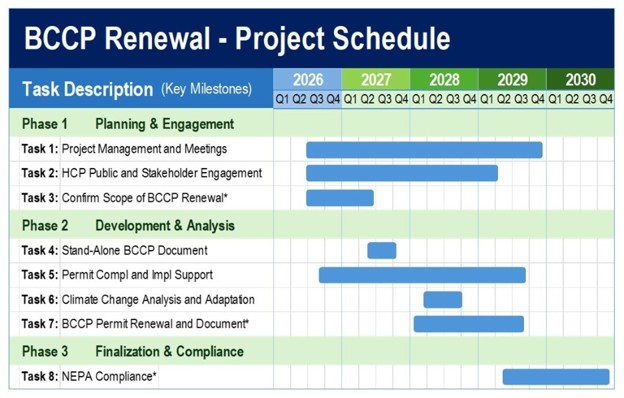
The following represents the current 4-year schedule to complete all phases of the BCCP renewal process including National Environmental Policy Act (NEPA) compliance. The schedule is subject to change and therefore, schedule updates may be posted on this webpage as appropriate.
Opportunities to Get Involved
Throughout the permit renewal process there will be regular opportunities for the public and other interested parties to obtain information on the Plan update and engage in the process. Below are some of the opportunities to be aware of.
BCCP Coordinating Committee Meetings
The BCCP Coordinating Committee (“Committee”) oversees the administration and implementation of the BCCP. One elected official from each Travis County Commissioners Court and the City of Austin’s Council preside on the Committee which is administered by the BCCP Officer. Publicly available meetings are held at least twice each year although more frequent meetings are expected during the BCCP renewal process. Up-to-date meeting information and materials may be found at the City of Austin’s BCCP Coordinating Committee webpage.
Participation in the Citizen Advisory Committee (CAC)
Apply for CAC Membership Consideration
Applications must be submitted by January 8, 2027, 11:59pm (CST) to be considered for CAC Membership.
A CAC will be established for the BCCP renewal process in accordance with Texas Parks & Wildlife Code §83.016 to Travis County and the City of Austin’s preparation of the renewed BCCP and associated permit application. The CAC will serve to represent the interests of local communities and landowners by providing input to help inform land use strategies and conservation efforts. Members will review relevant materials, participate in discussions, and offer input on the Plan’s structure and public-facing components.
The CAC will be made up of private citizens within Travis County. with at least four members or 33% of the CAC, whichever is greater, owning undeveloped or agricultural land within the planning area (Travis County). Landowning members may not be employees or elected officials of Travis County or City of Austin or other government entity. The Texas Parks and Wildlife Commission will also appoint one voting representative to the CAC.
Travis County residents are encouraged to apply for CAC member consideration (see link above). CAC members will be formally appointed by the BCCP Coordinating Committee.
Participation in the Biological Advisory Team (BAT)
Apply for BAT Membership Consideration
Applications must be submitted by January 8, 2027, 11:59pm (CST) to be considered for CAC Membership.
A BAT will be established in accordance with Texas Parks & Wildlife Code §83.015 to provide biological guidance during development of the renewed BCCP. Specifically, the BAT will assist with quantifying impacts to endangered species and the sizing and configuration of habitat preserves.
The BAT will consist of three or more professional biologists, with one member appointed by the landowning members of the CAC and one member appointed by the Texas Parks and Wildlife Commission, who will serve as the BAT’s presiding officer. The BCCP Coordinating Committee will appoint additional BAT members based on the recommendations of the BCCP administration team (Travis County and City of Austin BCCP administration and implementation leads).
Professional biologists interested in serving on the BAT are encouraged to apply for member consideration (see link above). While applicants are not required to reside in Travis County, BAT members will be required (on occasion) to attend meetings in Travis County.
Public Comment Opportunities
Multiple opportunities will be available throughout the BCCP renewal process for the public to provide input, including in-person and virtual meetings, online surveys, and formal public comment periods. When these comment periods are open, the public are encouraged to share input on topics such as species protection, development and infrastructure needs, best management practices, wildfire risk, public access and recreation, and other public interest matters related to the future of the BCCP. Noticing of formal public review for the updated BCCP will occur through a Notice of Availability (“NOA”) in the Federal Register. Additionally, this webpage will be updated as needed with information about opportunities for the public to provide written or verbal input on the BCCP renewal.
Email List Serve
Periodic updates on the renewal process, including notifications of publicly accessible meetings, engagement events, and Plan related comment periods, will be provided via email to those included on the BCCP List Serve.
BCCP Partnership Participation
The BCP is an assemblage of protected habitat – owned and managed by various public agencies, non-profit organizations, and private landowners (“BCCP Partners”). BCCP Partners will serve an important role during the BCCP renewal process by providing their on-the-ground experience and insights to guide updates to the Plan. Over the coming months, the BCCP Officer will contact BCCP Partners to share additional information, offer opportunities to participate and gather relevant input about preserve management and long-term conservation goals.
Regulatory Governance
The BCCP renewal is being conducted pursuant to Section 10 of the Endangered Species Act and Chapter 83 of the Texas Parks and Wildlife Code. Chapter 83 establishes requirements for regional habitat conservation plans (“plans”) developed by local government entities and provides for participation by the Texas Parks and Wildlife Department through the CAC and BAT.
The renewed BCCP will be developed in coordination with the Texas Parks and Wildlife Department and the U.S. Fish and Wildlife Service. The renewed plan and associated permit application will proceed through applicable local approvals, including the BCCP Coordinating Committee, Austin City Council, and Travis County Commissioners Court, followed by federal review and permit issuance by the U.S. Fish and Wildlife Service.
The renewal process will also be conducted in accordance with applicable state transparency requirements. Public BCCP renewal meetings, including CAC and BAT meetings, are subject to applicable requirements of the Texas Open Meetings Act, and records associated with development of the renewed BCCP are subject to the Texas Public Information Act, as applicable.
Frequently Asked Questions
Under the Federal Endangered Species Act (“ESA”), “take” is broadly defined to include actions such as harassing, harming, pursuing, wounding, killing, trapping, capturing, or collecting protected species. An incidental take is when these effects occur to a federally listed species but are not the purpose of the activity.
Can’t find what you’re looking for?
If you can’t find information about a specific permit or need help, fill out the Contact & Feedback Form. We will get back to you shortly.
You can also request a pre-application meeting to discuss any questions about your project by submitting a Request a Pre-Development Meeting.
For other ways to reach us, visit our Contact page.